
A development site rarely fails because of one dramatic engineering problem. More often, viability is eroded by a chain of small assumptions: an outfall that is not available, a finished floor level that cannot meet access gradients, a retained wall that needs temporary works, or a foundation strategy that no longer fits the ground conditions.
Those issues matter before purchase, before option agreements are finalised and before the planning layout becomes too politically or commercially fixed.
At acquisition stage, structural and civil engineering due diligence is not detailed design. It is a focused test of the assumptions sitting behind the land value, the planning strategy and the proposed construction route.
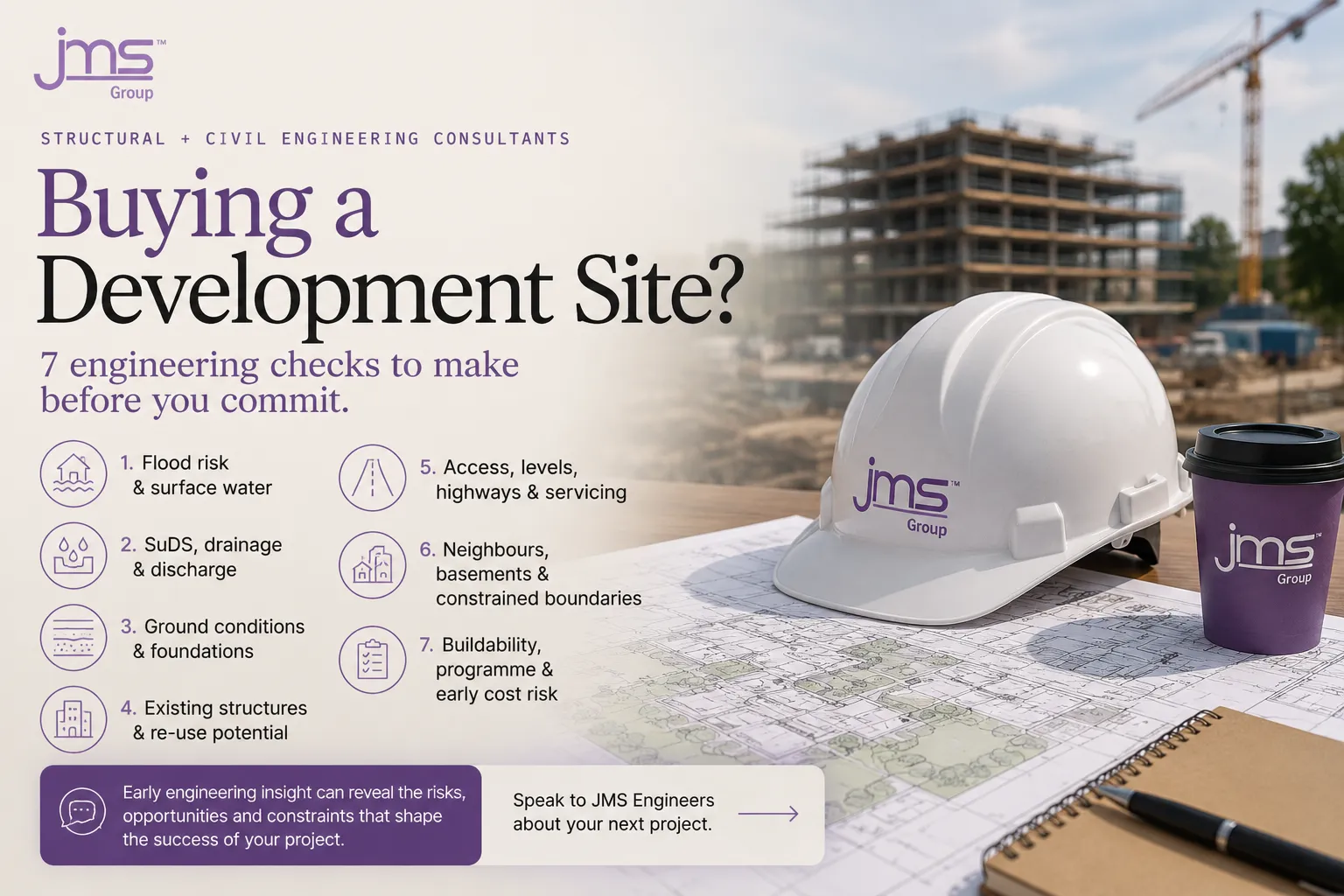
For developers, landowners, architects and planning consultants, these are the seven checks JMS Engineers would want to understand before a site is treated as straightforward.
1. Flood risk, exceedance routes and finished floor levels
A flood risk review should go further than asking whether the site is inside a mapped river or tidal flood zone.
For many residential, commercial and mixed-use sites, the more awkward constraint is surface water. Overland flow paths, low points, highway runoff, neighbouring land levels, culverted watercourses and historic drainage routes can all influence where water wants to go during an extreme event.
That can affect developable area, safe access, emergency routes, undercroft parking, threshold levels, external gradients and the relationship between a new building and surrounding land.
A finished floor level that looks sensible in an architect's early plan may become difficult once flood resilience, level access, ramps, retaining walls and drainage falls are tested together.
2. SuDS feasibility, outfall and adoption risk
Drainage is one of the fastest ways for a promising site to become less simple than it first appeared, especially when the outfall, storage volume and site levels have only been assumed.
The early question is not just whether SuDS can be shown on a plan. It is whether the site has a credible surface water hierarchy, enough space for attenuation, realistic maintenance access and a discharge route that can be agreed.
Infiltration may look attractive until ground conditions, groundwater, contamination, nearby basements or BRE 365 testing make it unsuitable. A sewer connection may look obvious until capacity, invert levels, easements or third-party land create delay. Attenuation may appear manageable until the layout has no usable space left for tanks, basins, permeable paving build-ups or exceedance routes.
On constrained sites, drainage can also compete directly with tree protection zones, parking, refuse tracking, utilities, public open space and substructure design.
3. Ground conditions and substructure allowances
At land appraisal stage, foundations are often represented by a line in a cost plan. On site, they are where uncertainty becomes concrete, steel, spoil and programme.
Made ground, shrinkable clay, groundwater, buried slabs, old foundations, culverts, contamination, tree influence, adjacent basements and historic demolition can all change the substructure strategy.
The difference between shallow pads, trench fill, rafts, mini-piles, CFA piles, ground beams or local retaining works is not just technical. It can change cost, sequencing, site logistics, spoil movements and the amount of design coordination needed before construction.
This is particularly important for infill sites, brownfield plots, former commercial yards, backland developments and sites close to mature trees or neighbouring structures.
4. Existing structures and reuse potential
Existing buildings can be the best opportunity on a site, or the risk that has not yet been priced into the acquisition, planning strategy or construction budget.
For office-to-residential conversions, upward extensions, refurbishments, change-of-use schemes and partial demolition projects, the structure needs to be understood before the planning story leans too heavily on reuse.
Early checks should consider load paths, column grids, foundation capacity, floor loadings, lateral stability, roof structure, historic alterations, movement, corrosion, moisture, cracking and whether the building can accept new stairs, lifts, plant, terraces, solar panels or additional storeys.
Retaining structure can reduce embodied carbon and support a stronger planning narrative, but only when the retained frame, walls, floors and foundations are genuinely compatible with the proposed use.
5. Access, levels, highways and servicing
A site can look efficient in plan and still fail the practical test of movement once access gradients, vehicle tracking, drainage falls and servicing routes are added.
Pedestrian access, vehicle tracking, refuse collection, fire appliance access, cycle storage, parking gradients, visibility splays, road tie-ins, service corridors, drainage falls and accessible thresholds all compete for the same geometry.
This is where levels become commercially important. Moving a building up or down by a few hundred millimetres can affect retaining walls, ramp lengths, below-ground drainage, flood resilience, boundary treatments and the relationship with neighbouring plots.
For tight urban sites and sloping plots, early civil engineering input can prevent a planning layout from promising access arrangements that later require expensive compromise.
6. Boundaries, party walls, basements and temporary works
The edge of the site is often where the engineering risk sits, particularly on infill plots, basement schemes and developments close to existing buildings or highways.
Basements, boundary retaining walls, deep excavations, underpinning, adjacent foundations, party wall matters, nearby highways, rail assets, utilities and restricted crane or plant access can all affect how a scheme is delivered.
A basement may improve floor area, but it can also introduce groundwater control, temporary propping, secant or contiguous piled walls, sequencing risk, party wall sensitivity and a much greater need for construction-stage coordination.
Likewise, a landlocked site may be structurally achievable but commercially fragile if steelwork, piling rigs, concrete wagons, excavation plant or spoil removal cannot be managed efficiently.
7. Buildability, sequencing and early cost risk
Planning potential is not the same as deliverability, and a layout that looks viable in a land appraisal can still carry unresolved construction risk.
A site may have a plausible massing study and still carry unresolved engineering risks around sequencing, temporary stability, drainage diversions, service clashes, retained structure, material access, excavation support or late investigation findings.
This is where early engineering advice can protect the programme. It helps the team understand which assumptions are robust, which need surveys, and which could change the design once consultants, contractors and statutory bodies become involved.
For a developer, the value is not simply finding problems. It is identifying the constraints early enough to price them, design around them or renegotiate the risk before committing too far.
What early engineering due diligence can include
The right scope depends on the site, but an early JMS review may include:
- Site walkover and engineering constraints note
- Review of topographical survey, utilities information and historic mapping
- Flood risk screening and finished floor level advice
- Drainage and SuDS feasibility review
- Access, levels, servicing and vehicle tracking considerations
- Initial foundation and substructure strategy advice
- Structural inspection of existing buildings
- Basement or retaining wall feasibility comments
- Identification of surveys, CCTV, trial pits or ground investigation needed next
The aim is not to replace detailed design. The aim is to make the critical unknowns visible early enough to shape the offer, the planning layout and the project brief.
When should developers involve JMS Engineers?
The useful moment is usually before the site feels fixed: before purchase, before an option is exercised, before planning submission, before the architectural layout is treated as final, or before a contractor is asked to price a scheme on assumptions that have not been tested.
Early engineering input does not need to slow a project down. Done well, it gives the client and design team a clearer route through the constraints that would otherwise appear later, when they are harder and more expensive to solve.
Thinking about a development site?
Before committing to a site, look beyond the headline opportunity. Flood risk, SuDS, drainage, ground conditions, existing structures, access, boundaries and buildability can all influence whether a development is practical and commercially viable.
JMS Engineers supports developers, architects, planning consultants, contractors and landowners with early-stage structural and civil engineering advice across residential, commercial and mixed-use projects.
Considering a development site? Speak to JMS Engineers about pre-planning engineering due diligence before the key risks are locked in.